How much does it cost to paint a house in Seattle? (2026 pricing)
Most online painting calculators are wrong for Seattle. Here is what a real 2026 quote looks like — line by line — and what actually drives the number up or down.
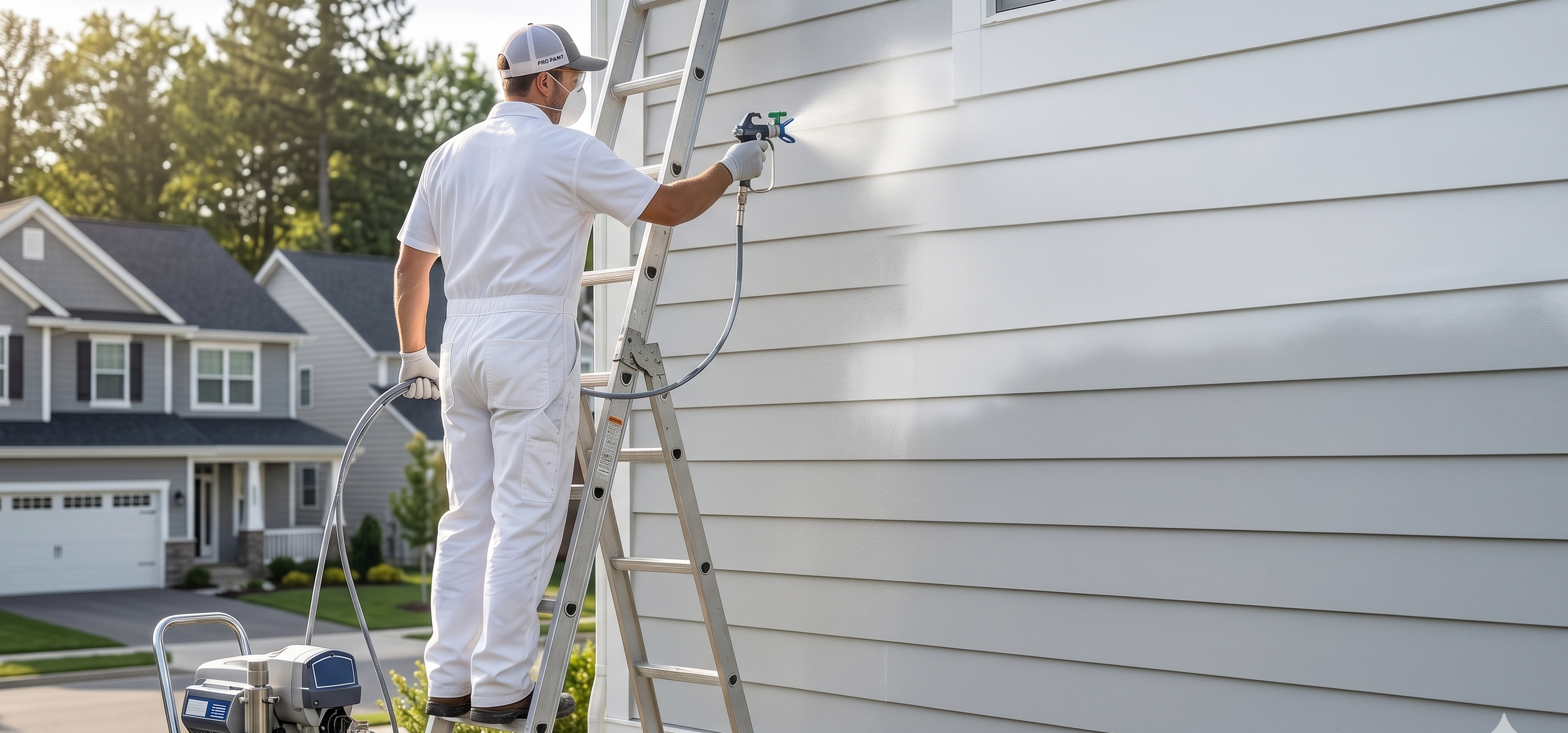
Most “how much does it cost to paint a house in Seattle” calculators are pulled from national averages, scaled by a ZIP code multiplier, and presented like they describe reality. They don’t. Seattle homes have cedar siding, three stories of gables, north-facing walls that grow moss, and a wet season that dictates when paint can even go on the wall.
This is the breakdown we actually use when we walk a property and write a quote. If you’re getting bids right now, you should be able to read each one against this list and see exactly where the price is coming from.
The short answer
For a typical Seattle-area home in 2026, here’s what a fair, fully-prepped repaint costs:
- Interior repaint, full house — $4,500–$11,500 for a 1,500–3,000 sq ft home (walls, ceilings, trim, doors)
- Interior, walls only — $2,800–$6,500 for the same footprint
- Exterior repaint — $7,500–$14,500 for a typical 2,000–2,800 sq ft, two-story Seattle home
- Exterior with heavy prep or cedar siding — $12,000–$22,000+
- Fence and deck restain — $1,800–$5,500 depending on linear feet and condition
Those ranges assume premium acrylic paint, two finish coats, full prep, and a W-2 crew that pulls permits where needed. If a quote is meaningfully below the bottom of these ranges, something is missing — either the prep, the coats, or the workers’ comp insurance.
What’s actually in the price
Every painting quote, simplified, is the same five line items. Different contractors weight them differently, but the buckets are universal.
1. Setup and protection
This is the day-one work nobody photographs: drop cloths, plastic over cabinets, removing outlet covers and switch plates, masking off windows, moving and rewrapping furniture. On an interior repaint of a furnished house, expect 4–8 hours of crew time before a brush touches a wall. Skipping it is how cheap contractors hit cheap prices — and why their finished jobs come with paint flecks on hardwood.
2. Prep work
Prep is where good paint jobs are made and where bad ones are doomed. The honest version:
- Wash — exteriors need a controlled, low-pressure wash 48+ hours before primer. Pressure-washing with a homeowner-grade wand drives water under siding and into wall cavities; that water shows up as paint failure 18 months later.
- Scrape — every flaking edge has to come off. On a 1990s Seattle Craftsman with original trim, scraping alone can be 12–20 hours.
- Sand and feather — scraped edges have to be sanded into the surrounding paint so the new coat doesn’t telegraph the transition.
- Caulk and patch — every failed caulk joint on trim, fascia, and window casings gets cut out and re-caulked with paintable polyurethane. Drywall patches inside get skim-coated and sanded twice.
- Prime — bare wood, stains, repairs, and any color change going lighter all get spot-primed or full-primed.
Prep is also where quotes diverge most. On the same house, a $7,200 bid and an $11,500 bid usually agree on the paint. They disagree on how many hours of scraping and caulking is honest work versus optional.
3. Paint and materials
For an interior repaint of an average Seattle home, materials typically run $400–$900. For an exterior, $900–$2,200. We use Sherwin-Williams Emerald or Benjamin Moore Aura on most exteriors because they hold up to PNW UV and wet seasons longer than contractor-grade lines. The premium runs about $30/gallon over base — call it $400 on a whole-house exterior. Not the place to save money.
4. Application labor
This is the biggest line item: 55–70% of any honest quote. Two coats means two coats. “One coat with cut-in” isn’t two coats, it’s one coat and a half-truth.
For exteriors, application time on a 2,500 sq ft Seattle home is typically 80–140 crew-hours. Interiors with full trim and doors run 60–120 hours. Anybody quoting a turnkey 3-day interior repaint of a fully-furnished, lived-in 2,500 sq ft house is either staffing it with 6 painters or skipping prep.
5. Overhead, insurance, and warranty
A contractor running W-2 crews, paying workers’ comp, carrying general liability, registering with L&I, and standing behind a written 2-year warranty is carrying roughly 18–28% of revenue in overhead. Backyard operators avoid most of those costs. That’s where their lower bids come from — and where their disappearing-act becomes possible after the deposit clears.
What drives the number up
When we quote, these are the factors that move a house up the range:
- Height — anything above one story adds setup time. Three-story Seattle homes on steep lots add staging, sometimes scaffolding.
- Trim density — a Tudor with 9 windows per side, gingerbread fascia, and three porches takes triple the brush time of a flat stucco rambler.
- Cedar siding — beautiful, expensive to keep alive. Cedar needs more aggressive prep, often a dedicated primer coat, and benefits from a stain rather than paint.
- Color change going darker → lighter — three coats minimum, sometimes a tinted primer first.
- Lead paint — homes built before 1978 are presumed to have it. EPA RRP-certified prep is required and adds $400–$1,500.
- Vaulted ceilings, two-story foyers, stairwells — anything that needs a ladder larger than an 8-foot step adds time.
- Wallpaper removal — quoted separately, almost always more than people expect. A real wallpaper removal on glued, painted-over paper can run $4–$7 per sq ft alone.
What drives the number down
The honest ways to lower a quote:
- Walls-only refresh — skipping ceilings, trim, and doors can cut an interior quote by 35–55%.
- Same color repaint — one-coat coverage is realistic on a same-color, premium-paint refresh. Quote should reflect it.
- Off-season scheduling — for interiors, December–February crews often have capacity and may discount 5–10%.
- Single-story access — saves staging time.
- You move and protect furniture — saves 2–6 hours of crew time on a furnished home.
The dishonest ways:
- Spec’ing contractor-grade paint
- Skipping caulk replacement
- “Touching up” instead of two-coating bare wood
- Bidding it as “one coat”
- Paying a contractor in cash, off-the-books
Any of those will save you money this year and cost you more inside three years.
Reading a quote like a contractor
The right way to compare three quotes:
- Confirm the paint product and number of coats are written in. Not “premium paint.” The actual product name and SKU.
- Confirm prep scope is itemized. Scrape, sand, caulk, prime — each named separately.
- Confirm warranty language is in writing. A verbal “we stand behind it” is worth zero in 14 months.
- Confirm proof of insurance and L&I registration — for Washington, the contractor should be on the L&I license lookup under their own legal name.
- Compare crew structure. W-2 crews on the same project all season vs. rotating subs is a major quality variable.
If a quote can’t survive those five questions, the price doesn’t matter.
When the number on the page is fair
A fair Seattle painting quote should pass three tests:
- It matches a logical hourly figure when you back-calculate (roughly $65–$95/hour for a 2-person crew, including materials and overhead).
- It names the paint and the warranty in writing.
- It survives a follow-up conversation about prep without the contractor getting defensive.
The cheapest quote almost never wins on a 7-year horizon. The most expensive quote isn’t always right either — sometimes it’s a brand premium that doesn’t translate to better work. The middle quote, with the most specific prep scope, usually does.
If you want to see what a fully-itemized NorthLine quote looks like before you commit to anything, book a 24-hour estimate or call the shop. We’ll walk the house, write it up the same way for you that we wrote it up here.
On this topic
Reader questions
In 2026, a full exterior repaint on a typical 2,000–2,800 sq ft Seattle home runs $7,500–$14,500. The range widens for two-story, cedar-sided, or trim-heavy homes. The single biggest cost driver is prep time, not paint.
Wall-only repaints run roughly $2.50–$4.50 per sq ft of floor area in Seattle. Adding ceilings, doors, and trim typically pushes the total to $4–$7 per sq ft. Houses with vaulted ceilings, heavy texture, or color changes from dark to light land at the upper end.
Most of the difference comes down to prep scope (how many coats of failing paint get removed), paint tier (contractor-grade vs premium acrylic), and labor classification (W-2 crews vs day-labor sub-subs). A 30% spread between two honest quotes on the same house is normal.
Reputable Seattle painters quote by the project after an in-person walk. Per-square-foot pricing is fine for ballparks but breaks down on real homes — eaves, soffits, dormers, and gables don't show up on a calculator.
For exterior work in Seattle, materials are typically 12–18% of the total. For interior work, 8–14%. The rest is labor and overhead. Anyone selling "cheap paint" as the headline is hiding where the actual money goes.
Sometimes 5–10% for interior work because crews are slower. Exterior savings in winter are usually false economy — applying paint outside the manufacturer's temperature window voids the warranty and shortens the finish's life by years.
The four most common surprises: lead-paint testing on pre-1978 homes, failed-caulk replacement at trim joints, sheen-mismatch touch-ups on walls that weren't bid for two coats, and "extra" trim color changes that were assumed to be the same color as the body.
Keep reading
Related field notes.
Best time of year to paint your home exterior in Washington
The painting industry pretends the season runs May through October. In Western Washington, the real window is shorter — and the cost of getting it wrong is paid in years, not weeks.
How to choose a painting contractor: questions to ask
A great painter and a terrible painter often quote within 15% of each other. The difference is in twelve questions you can ask in twenty minutes — and the answers tell you everything.
Interior vs exterior paint — what is actually different?
It is not marketing. Exterior and interior paints are formulated to solve completely different problems. Using one where the other belongs is a slow-motion mistake.