How to paint kitchen cabinets like a professional
Painting cabinets is the most unforgiving paint work in a house. Get the prep wrong, the product wrong, or the sequence wrong and the finish tells on you within months.
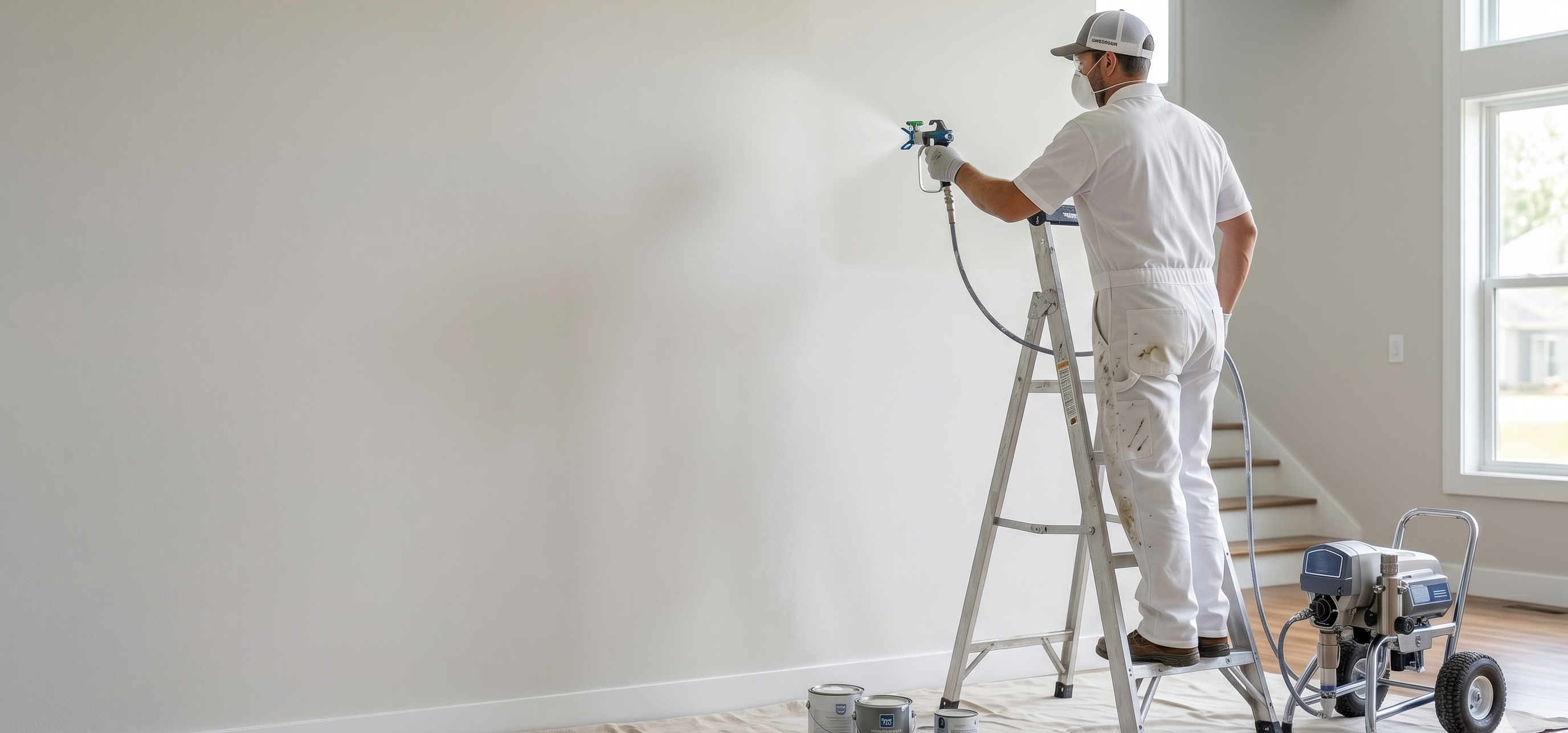
A painted cabinet finish has to survive things that a wall finish never sees: grease, steam, fingernails, dishrags, the corner of a pan brushing against it, the hinge being slammed three thousand times a year. That’s why cabinet painting is the most unforgiving paint work inside any house.
It’s also why a great cabinet paint job is worth what it costs — and why a bad one fails so visibly. This is the system we use to make cabinets that hold up.
Why most DIY (and cheap-pro) cabinet jobs fail
Before the process, the failure modes. Almost every cabinet repaint that goes wrong fails in one of these five ways inside year one:
- Adhesion failure. Paint lifts off in strips when a fingernail catches it. Caused by insufficient scuff-sanding or skipping the degreaser pass.
- Tannin bleed. Yellow or brown stains rise through white paint from the wood underneath. Caused by skipping a stain-blocking primer on bare or partially-bare wood.
- Edge wear. The paint at door corners, drawer edges, and rail bottoms wears off first because the film is too thin and the product is too soft.
- Hinge contamination. Paint flecks where hinges sit, paint locked in hardware holes, paint webs between door and frame. Caused by not removing hardware completely.
- Visible brush and roller marks. Topcoat applied with the wrong product, wrong technique, or insufficient open time.
The system below is designed to prevent all five.
The realistic timeline
A real cabinet repaint takes time. The compressed version anyone is selling you in 3 days is skipping cure time.
Working schedule for a typical 30-linear-foot kitchen:
- Day 1: Remove all doors, drawer fronts, and hardware. Label every piece. Wash all surfaces with degreaser. First scuff-sand. Transport doors to shop or staging area.
- Day 2: Mask off counters, appliances, walls, and floors. Sand cabinet boxes in place. Vacuum and tack-cloth everything.
- Day 3: Prime cabinet boxes (brush and roll). Spray-prime doors and drawer fronts off-site.
- Day 4: Cure day for primer. Light sand. Tack-cloth.
- Day 5: First topcoat on boxes (brush and roll). Spray first topcoat on doors and drawer fronts.
- Day 6: Cure day. Light sand. Tack-cloth.
- Day 7: Second topcoat on boxes. Spray second topcoat on doors and drawer fronts.
- Day 8–9: Full cure. Light buff if needed.
- Day 10: Rehang doors, reinstall hardware, replace drawer fronts, walk-through with the homeowner.
Anything materially faster than this — particularly skipping the cure days between coats — is the source of the failure modes above.
The prep that actually matters
In cabinet work, prep is 60–70% of the total labor and 100% of the long-term durability. The non-negotiables:
Remove everything
Every door comes off. Every drawer front comes off. Every hinge, knob, pull, and bumper comes off. Doors get numbered with painter’s tape and corresponding labels inside the box openings.
This is the step that separates pros from “we’ll just mask around the hinges.” Painting cabinets in place looks fine for six months and then the hinge-line shows where the masking tape sat, every time.
Degrease
Cabinets — especially the ones near the stove and range hood — are coated in a film of cooking grease that’s invisible until you wipe it. Paint will not bond to grease. Period.
The system:
- TSP substitute (or a dedicated degreaser like Krud Kutter Original) wiped on every surface
- Followed by a clean-water rinse wipe
- Followed by a dry wipe
- Followed by full dry time
This is non-negotiable. Even on cabinets that look spotless. Especially on cabinets above the range.
Scuff-sand to 220-grit
Every surface — boxes, doors, drawer fronts, rails, stiles, profile detail — gets sanded with 220-grit. The goal isn’t to remove the existing finish. It’s to break the gloss and create a microscopic tooth for the primer to bond to.
Power sanders work for flat surfaces. Hand-sanding (with a sanding block) is required for profile details. A skipped corner is a future failure point.
After sanding: vacuum, then wipe with a tack cloth. Dust on the surface at primer time is dust embedded in the finish forever.
Prime correctly
The right primer depends on the cabinet:
- Previously painted cabinets in good condition: a bonding primer like Sherwin-Williams Extreme Bond or Zinsser Bullseye 1-2-3 (waterborne)
- Stained or oiled wood (oak, cherry, maple stained): an oil-based or shellac-based stain-blocking primer (Zinsser BIN, Zinsser Cover Stain) to prevent tannins from bleeding through
- Bare wood after sanding through: the same stain-blocking primer as above
Primer is sanded between coats (light pass with 320-grit) and tack-clothed before the topcoat. One coat of primer is usually enough; two is sometimes needed on raw wood.
The product that actually works
Standard interior wall paint will not survive on cabinets. You need a specialty enamel — a product engineered for hard, durable, scuff-resistant, washable surfaces.
The working professional defaults:
Benjamin Moore Advance (waterborne alkyd)
The cabinet paint we reach for most often. Levels like an oil-based paint without the off-gas, the cleanup, or the yellowing. Cures to an extremely hard, washable finish. Excellent flow and open time for brush work. Sprays beautifully.
Available in matte, satin, semi-gloss, and high-gloss. Satin is the most common cabinet sheen — soft enough to hide minor surface texture, hard enough to scrub clean. See our brand comparison for more on where Advance fits.
Sherwin-Williams Emerald Urethane Trim Enamel
The strongest direct competitor to Advance. Slightly more aggressive cure, very hard final finish, excellent stain resistance. Some painters prefer it for high-traffic family kitchens. Slightly less forgiving open time than Advance, so harder to brush.
What to avoid
- Standard wall paint (eggshell, satin in standard lines). Not formulated for cabinet wear. Will scuff and stain inside a year.
- Cabinet “kits” sold at big-box stores. Most are tinted bonding primers with a thin topcoat. They look great on day one and rough by month nine.
- Chalk paint without a topcoat. Beautiful for furniture in low-traffic rooms. Disaster on a kitchen cabinet door that gets touched 50 times a day.
Application: brush and roll vs spray
For the cabinet boxes (the parts that stay in place), brush and roll is standard. A high-quality angled sash brush for cut-ins and a 4-inch foam mini-roller for flat areas. Two coats with adequate dry time between.
For the doors and drawer fronts, spray application is dramatically superior:
- No brush marks
- No roller stipple
- Even film build across detail and flat areas
- Faster, with the doors laid out and sprayed in a controlled environment
This requires an HVLP sprayer, a clean spray booth or controlled space (a garage with plastic sheeting and a box fan can work), and the experience to gun a consistent pass. It’s the single biggest reason DIY cabinet repaints look different from professional ones.
If you’re DIYing without spray equipment, foam rollers and a self-leveling enamel (Advance) get you 80% of the way there. Visible brush marks at the door corners are the giveaway.
After the job
When the cabinets go back together:
- Felt-pad the corners where doors meet boxes. Even cured enamel will dent if metal hinge slams paint-on-paint for ten years.
- Replace hardware — even if the old pulls are fine. New paint and old hardware always tells. If you don’t want to replace, at least clean and polish.
- Wait two weeks before heavy use. Acrylic enamels are dry-to-touch fast but reach full cure over 14–30 days. Avoid loading the cabinets with heavy dishes, slamming doors, or aggressive cleaning during this window.
- Save and label one quart of each color. A small artist’s brush touch-up at year 3 saves a full repaint at year 7.
How to keep them looking good
The honest maintenance list:
- Wipe spills immediately with a damp microfiber cloth and mild dish soap
- No abrasive cleaners, no magic erasers, no bleach-based wipes
- Don’t slam doors or load them with heavy hangers
- Address chips and nicks promptly with leftover paint
- Plan to touch up edge wear around year 4–5
Done right, a professionally repainted kitchen looks great at year 5 and acceptable at year 8. That’s the realistic outcome. Anyone promising better is selling you a marketing story.
If you’re considering a kitchen cabinet repaint, we can walk it and quote it with a full written scope — including the day-by-day timeline, the specific products, and the warranty terms.
On this topic
Reader questions
Yes — but only with the right prep, the right product, and the right application. A professional cabinet repaint can look and perform indistinguishable from factory-finished cabinets for 6–10 years. A bad cabinet paint job shows wear in less than one.
For a typical 25–35 linear foot kitchen, professional cabinet repaints in Seattle run $3,500–$7,500 in 2026. The range depends on cabinet box construction, door style, primer and topcoat selection, and whether hardware and hinges are replaced.
Typical professional cabinet repaints take 5–10 working days. Doors and drawer fronts are removed, prepped, primed, and sprayed off-site or in a shop while the boxes are brushed and rolled on-site. Rushed timelines (under 4 days) almost always skip critical dry time between coats.
Benjamin Moore Advance is the working professional default — a waterborne alkyd that levels like an oil-based paint while remaining low-VOC and easy to apply. Sherwin-Williams Emerald Urethane Trim Enamel is the leading alternative. Both far outperform standard interior wall paints on cabinet surfaces.
Yes — full scuff-sanding with 220-grit minimum, followed by a tack-cloth wipe-down and a degreaser pass. Most cabinet failures trace back to skipped sanding, residual grease, or insufficient primer. There is no useful shortcut on this step.
Yes, but it requires more work than painting over previously-painted cabinets. Stained wood needs to be cleaned with degreaser, scuff-sanded thoroughly, and primed with a high-bond stain-blocking primer (oil-based or shellac) to prevent tannins from bleeding through.
Clean spills immediately with mild soap and water, avoid abrasive cleaners and magic erasers, use felt pads at door corners to prevent edge wear, and touch up any chips promptly with leftover paint. Treat them as fine furniture, not as walls.
Keep reading
Related field notes.
How long does interior paint last? When to repaint your home.
Interior paint does not just fade and die. It loses its battle with hands, sunlight, and time in a specific order. Once you know what to look for, you can plan ahead instead of reacting late.
Sherwin-Williams vs Benjamin Moore: which is better for your home?
Asking which brand is better is asking the wrong question. Asking which product, in which line, on which substrate, in which climate is the right question.
How to prepare your home for an interior paint job
A small amount of homeowner prep before the crew arrives shortens the job, protects the things you care about, and makes for a much better finished result.