How to choose paint colors for your home (without regret)
Most paint regret comes from the same five mistakes. Avoid them, sample seriously, and you will land on colors you still like two years from now.
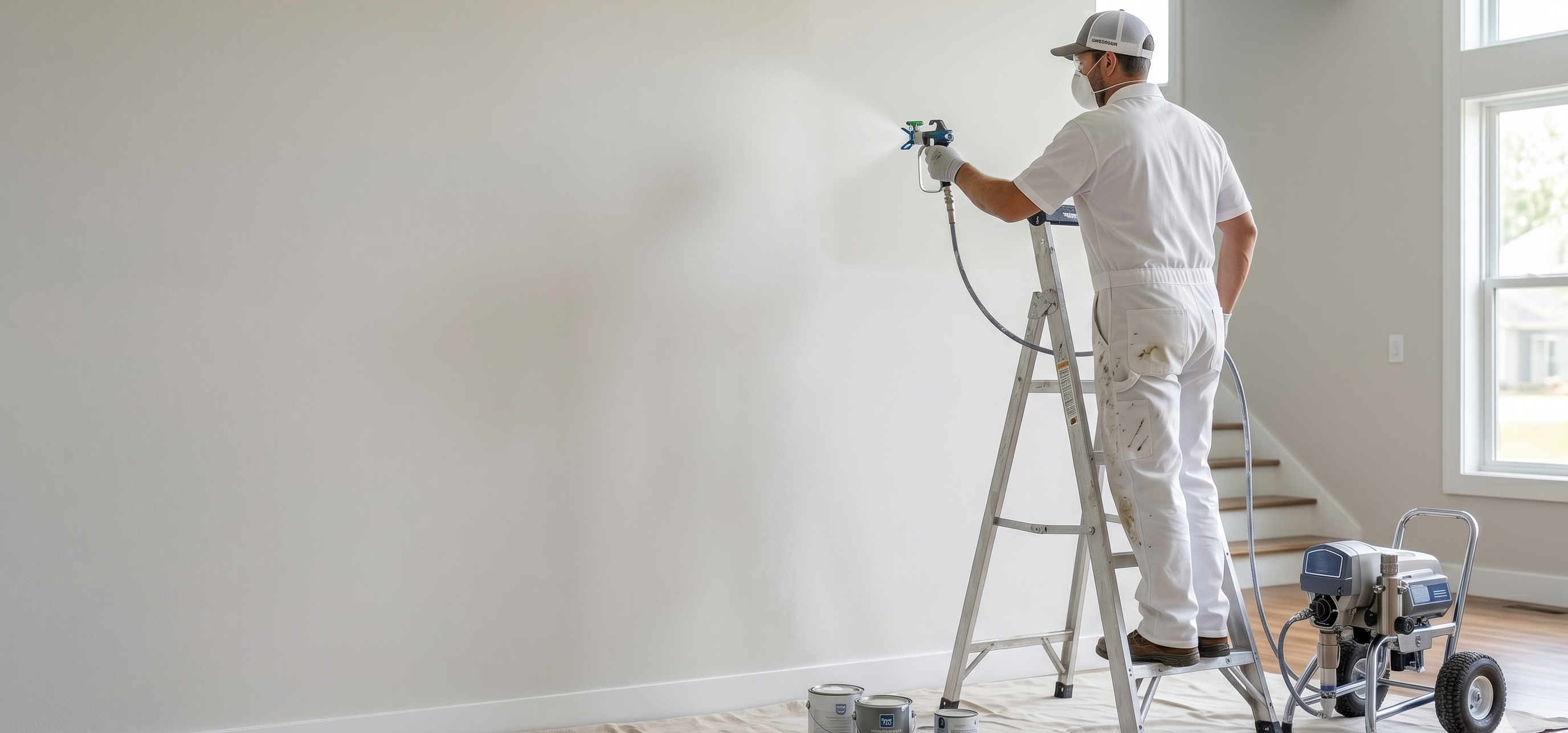
The single most common reason homeowners ask us to repaint within a year of a fresh paint job is that they made the wrong color decision. Not the wrong contractor. Not the wrong product. The wrong color — usually a beige that’s too pink, a gray that’s too blue, a white that’s too cold.
It’s a preventable failure. The path to a color you still like in five years is mechanical and repeatable. Here’s the version we walk every client through.
The five mistakes that cause paint regret
Before the process, the predictable traps:
- Choosing from a chip in the store. Store lighting is fluorescent, the chip is two inches, and your eye is calibrated to the rest of the paint section. Whatever you pick there will look meaningfully different in your room.
- Sampling too small. A 12 x 12 sample square reads ~25% more saturated than the full wall. You’ll choose richer colors than you mean to and walk into rooms that feel heavier than expected.
- Picking colors in isolation from the room’s fixed elements. Your trim color, floor color, and large furniture are what you’re decorating with. The wall color is the one variable. Pick it last, not first.
- Deciding in a single lighting condition. A beautiful 3 PM color can be a cold morning color or a sallow evening color.
- Letting a designer or store rep choose for you without sampling. Even good advice has to be tested in your room. The room is the only opinion that matters.
The process below is built to prevent all five.
Step 1: Start with what you can’t change
Before opening any paint deck:
- Photograph the floor in natural light. Note its dominant undertone — is it warm (orange, red, yellow)? Cool (gray, blue, green)? Mostly neutral?
- Photograph the trim. Is it bright white? Cream? Off-white with a slight pink, yellow, or gray cast?
- Identify your largest furniture pieces and any large permanent art. These create the visual anchors.
- Note the room’s primary natural light direction. North light is cool and constant. South light is warm and shifts through the day. East light is warm in the morning, dim by afternoon. West light is dim in the morning, warm and intense by evening.
Now you have constraints. Most paint decisions get made faster and better once the constraints are clear.
For example: warm oak floors + cream trim + south-facing windows naturally gravitate toward warm neutrals (whites with a yellow or red lean). Cool gray tile + bright white trim + north-facing windows naturally pair with cooler whites or grays.
This isn’t a rule. It’s the path of least friction.
Step 2: Narrow to 3–5 candidates
Open your paint deck (or the manufacturer’s website — see our take on Sherwin-Williams vs Benjamin Moore if you haven’t picked a brand) and pull candidates that match your constraints.
For most rooms, you want:
- One safe, on-the-money color
- One slightly warmer/cooler version of it
- One slightly lighter/darker version
- One wild card
If you’re choosing white, this might be:
- Benjamin Moore White Dove (warm, soft, the safest bet)
- Sherwin-Williams Alabaster (slightly warmer, softer)
- Benjamin Moore Simply White (cleaner, less yellow)
- Sherwin-Williams Pure White (the wild card — cooler, more architectural)
The point of 3–5 is to give yourself a comparison set on the wall. Looking at one color alone is much harder than looking at four side by side.
Step 3: Sample on the wall, big
Buy actual sample pots (Benjamin Moore and Sherwin-Williams both sell them for $5–$10 each). Paint each candidate as a 2 ft x 2 ft minimum square. Larger is better.
Place the samples on two different walls — one that gets your room’s primary natural light, one that doesn’t. The same color reads dramatically different in direct light vs. shadow.
For each sample:
- Apply two coats (mimicking the real finished surface)
- Wait for full dry (overnight at minimum)
- Label each clearly in pencil along the edge
- Don’t put samples against trim. Leave 4–6 inches of existing wall around them. You want to see the candidate color on its own, not bordered by white.
For accent walls or dramatic colors, paint a full 4 ft x 4 ft block. A library full of Studio Green looks very different from a 2-foot square of Studio Green.
Step 4: View across lighting conditions
This is where most decisions go wrong. View your samples at:
- Sunrise — 6–7 AM
- Mid-morning — 9–10 AM
- Midday — 12–1 PM
- Late afternoon — 4–5 PM
- Evening with lamps on — 7–9 PM
- Overcast day — at any time during a typical PNW gray day
- Night with the overhead light off — many rooms only use lamps at night
Take a phone photo at each timepoint, of the same wall, with the same camera position. Compare. The samples you still like across all conditions are the live candidates.
A color that looks great at 2 PM Saturday and grim at 7 AM Wednesday is not the right color for a room you live in seven days a week.
Step 5: Stress-test against your priorities
For each finalist, ask:
- Does it work with the trim? Hold a trim sample (or a strip of trim-color painter’s tape) against each finalist. If the contrast is wrong, you’ll feel it every day.
- Does it work with your largest piece of furniture? Drape a throw or a pillowcase against the sample area in a color that matches your couch or rug.
- Does it sit well with adjacent rooms? Color flow matters in open floor plans. Stand in the adjoining room and look at the candidate through the doorway. Does it harmonize? Fight?
- Does it work at low light? Many people choose their colors during the day and forget that 12 hours a day in winter, they’re seeing the room at low light.
You’re looking for a color that’s calm in every condition. Not the most dramatic. The most consistent.
Step 6: Wait five days, minimum
Don’t decide on day one. Don’t decide on day two. Live with the samples for at least 5 days. Ideally a week.
Two things happen in this window:
- The novelty wears off and the color stops “looking like a sample” and starts “looking like the wall.”
- You catch the lighting conditions you didn’t anticipate — a particular afternoon hour, a winter overcast pattern, the way the kitchen light reflects.
Most homeowners change their mind by day 4. That’s data. The color you still like on day 7 is the one to commit to.
A few practical color rules
We don’t believe in arbitrary design rules, but these are durable:
- Cool grays read blue in Pacific Northwest light. A “neutral gray” in Phoenix looks neutral. The same color in a Seattle home in October reads slate blue. Test it.
- Off-white trim against cool walls makes the trim look dirty. Match warm with warm, cool with cool.
- Ceilings should be lighter than walls, almost always. Same-color ceilings can work in tall rooms with strong design intent; in standard rooms they make the room feel lower.
- Accent walls work when the architecture supports them (a wall with a fireplace, a recessed wall, a wall behind a bed). They feel arbitrary on a random wall.
- Saturated colors are not riskier than neutrals. They’re easier to fail with, but a confident deep green can be more livable than a wishy-washy beige. Sample seriously, then commit.
What a designer’s involvement actually adds
If you’re working with an interior designer or color consultant, what they’re providing isn’t “the right color” — they’re providing constraints, fast. They can narrow a deck of 4,000 colors to 5 in 20 minutes based on your room and your floor.
You still have to sample, view in your light, and live with the candidates. Skipping that step because the designer said so is the most expensive way to choose paint.
After you decide
Once you’ve committed to colors:
- Confirm the sheens with your contractor (see our prep guide)
- Buy and store one quart per color, sealed and labeled, after the project for touch-ups
- Photograph each room in natural light, labeled, for your own records
You’re now set up not just for a great paint job, but for an easy touch-up cycle for the next decade.
And if you’d like help walking the decision with someone who’s stood in 500+ Seattle living rooms holding sample cards: we can do a color consultation as part of any quote, free of charge.
On this topic
Reader questions
Start with the room's fixed elements (flooring, trim, large furniture), narrow to 3–5 candidates, sample large patches (2 ft x 2 ft minimum) on at least two walls in the room, and view them across multiple lighting conditions for at least 5–7 days before committing.
Three reasons: a 2-inch swatch cannot represent how a color reads on a full wall, store lighting (usually fluorescent) shifts colors in your eye, and your room's natural and artificial light fundamentally change how the color appears. This is why large samples in the actual room are non-negotiable.
Directly on the wall is more accurate. Poster boards introduce slight reflectivity differences and let you accidentally view colors against the wrong context. If you cannot paint directly, large unmounted sample boards held flush to the wall are second-best.
Minimum 2 feet by 2 feet. Smaller samples look more saturated than the full wall will, leading to predictable disappointment. For accent walls or dramatic colors, consider painting a full 4 ft x 4 ft block.
At least 5 days, ideally 7–10. You need to see the color at sunrise, midday sun, late afternoon, evening with lamps on, and overcast Pacific Northwest days. A color that looks great at 2 PM Saturday can read sickly at 7 AM Wednesday.
A flexible rule: one wall color, one trim color, one ceiling color, optionally one accent. Three or four distinct wall colors across an open floor plan rarely work. The trim and ceiling carry the consistency.
Warm neutrals continue to dominate — Benjamin Moore White Dove and Swiss Coffee, Sherwin-Williams Alabaster and Accessible Beige. For accents, deep greens (Studio Green, Hunter Green), warm clays, and refined navies are common. Cool grays have peaked.
Keep reading
Related field notes.
How to prepare your home for an interior paint job
A small amount of homeowner prep before the crew arrives shortens the job, protects the things you care about, and makes for a much better finished result.
Sherwin-Williams vs Benjamin Moore: which is better for your home?
Asking which brand is better is asking the wrong question. Asking which product, in which line, on which substrate, in which climate is the right question.
How long does interior paint last? When to repaint your home.
Interior paint does not just fade and die. It loses its battle with hands, sunlight, and time in a specific order. Once you know what to look for, you can plan ahead instead of reacting late.